
Football
Looking Back: Defense vs. Kansas State was a Problem, but Not the Only Problem

I know I’m on an island with this, and that’s fine. I don’t really care. I only care that we evaluate coaches and players fairly and properly. There is some combination of actually watching games and looking at the numbers that come out of those games that leads to this evaluation.
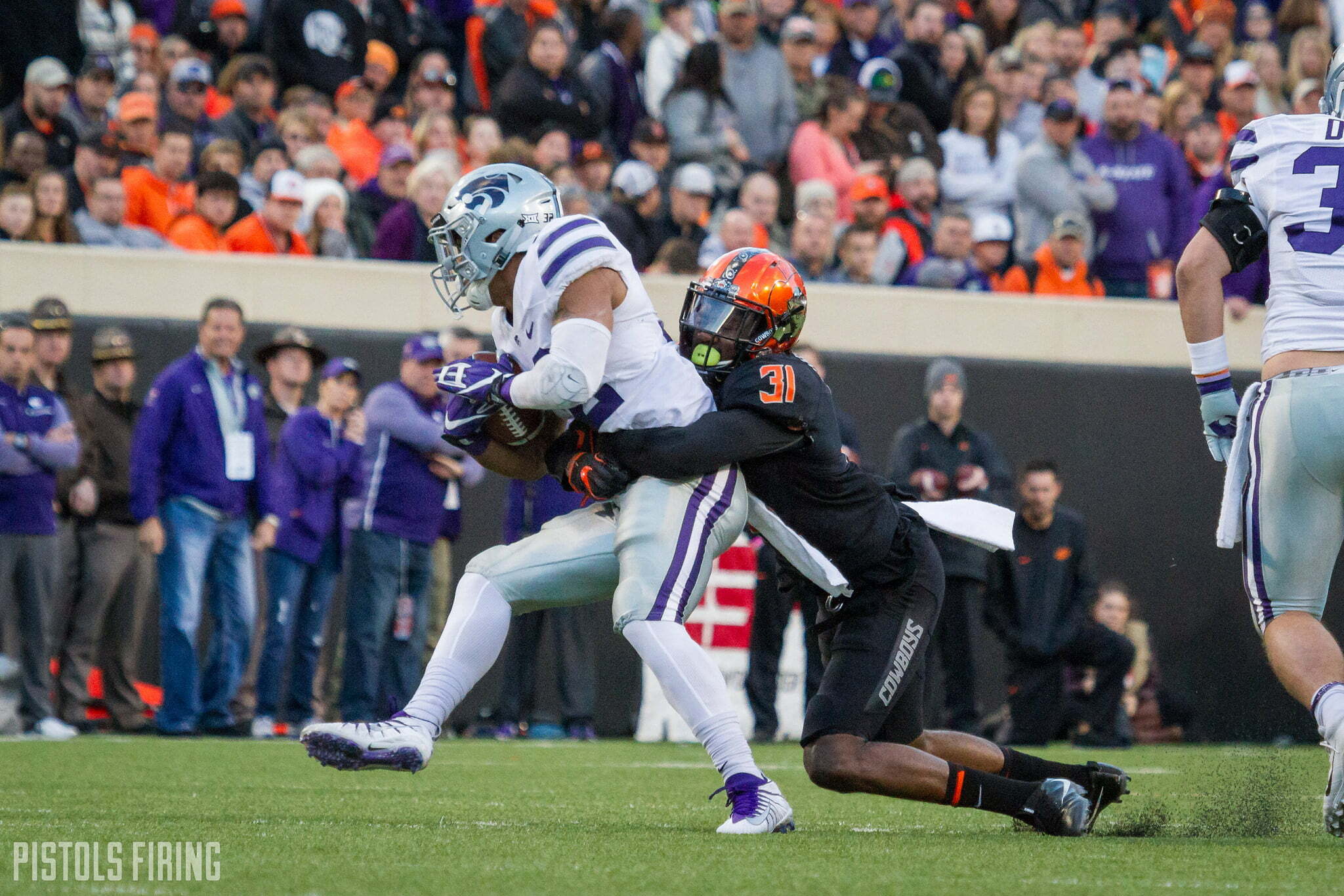
So with those cards on the table, I’ll say it: Oklahoma State’s defense wasn’t really that bad against Kansas State and is certainly not the reason the Pokes lost. Does that mean it was good? No, but consider the following.
Oklahoma State allowed 2.53 points per drive on Saturday against the Wildcats. That’s 38 points on 15 drives. Not ideal — that number would rank in the 90s nationally over the course of a season — but certainly good enough to win a football game when you have Oklahoma State’s offense playing Kansas State’s defense (which came into the game No. 6 in Big 12 play in PPD allowed).
Oklahoma State’s defensive performance was only slightly worse than what it did at Texas Tech. And I guess this is the rub for me. We have to stop looking at total points. Those of you who read this blog often are familiar with my worship at the alter of points per drive, but I don’t know what else I’m supposed to do here.
We cite a number of points in a given game as if the number of drives don’t matter. If you give up 45 points on 10 drives, that’s bad. If you give up 45 points on 30 drives, that’s incredibly good. It’s no different than a basketball player scoring 45 points on 15 shots vs. a basketball player scoring 45 points on 55 shots (so KD vs. Westbrook). One helps your team win, and the other doesn’t.
So the number of drives you face does matter. It has to. This is why when people kept saying after WVU, we back, we scored 50, I thought, but did you see how many drives it took? That was not a good offensive performance.
Anyway, based on that number, OSU’s defense was not good against Kansas State but not atrocious either. Now the flip side to this argument is that OSU actually allowed 3.2 points on the first 12 drives and Kansas State wasn’t really trying to score at the end. I acknowledge that.
However, the reality is that based on Kansas State’s offense (not that good but better than Iowa State’s and TCU’s) and the number of defensive drives OSU faced (15), the Cowboys actually nearly hit their expected number, or the number of points an average defense would give up against Kansas State. That’s what you guys want, right? If the defense could just be average!
It sort of was.
Defensive Performances (Worst to Best)
| Game | Opp. PPD | Drives | Expected | Actual | Difference |
|---|---|---|---|---|---|
| TCU | 1.99 | 13 | 25.9 | 44 | 18.1 |
| Iowa State | 2.00 | 14 | 28.0 | 42 | 14.0 |
| Oklahoma | 3.41 | 15 | 51.1 | 62 | 10.9 |
| KSU | 2.15 | 15 | 32.3 | 38 | 5.8 |
| Texas Tech | 2.47 | 12 | 29.6 | 27 | -2.6 |
| Baylor | 1.94 | 14 | 27.1 | 16 | -11.1 |
| WVU | 2.35 | 16 | 37.6 | 24 | -13.6 |
| Texas | 1.63 | 15 | 24.5 | 10 | -14.5 |
The offense, on the other hand, was pretty pedestrian as well. An average offense would have scored 37 points against KSU on 16 drives based on what the Wildcats. The Pokes scored 41 (I’m operating in these numbers as if TDs are worth 7). These numbers reflect the fact that OSU went nine (!) straight drives in the middle of the game without a touchdown. That’s terrible, and it resulted in the second-worst offensive performance of the season in the conference.
Offensive Performances (Best to Worst)
| Game | Opp. PPD | Drives | Expected | Actual | Difference |
|---|---|---|---|---|---|
| Iowa State | 1.41 | 15 | 21.2 | 48 | 26.8 |
| Baylor | 2.67 | 13 | 34.7 | 59 | 24.3 |
| TCU | 1.32 | 12 | 15.8 | 31 | 15.2 |
| Oklahoma | 2.63 | 15 | 39.5 | 52 | 12.5 |
| Texas Tech | 2.60 | 12 | 31.3 | 41 | 9.7 |
| WVU | 2.26 | 19 | 42.9 | 52 | 9.1 |
| KSU | 2.32 | 16 | 37.1 | 41 | 3.9 |
| Texas | 1.39 | 15 | 20.9 | 13 | -7.9 |
So we have established that the defense was slightly below average, and the offense was slightly above. Which leads to a terrific question from my buddy Matt Amilian: Is the barometer of how we rate the OSU defense dependent on how good our offense is to win games?
I think the way you think about that question determines how you feel about Oklahoma State’s defense in general. To me, I think if you’re saying “this is who we are, we’re going to be gunslingers, we’re going to score, we’re going to have elite offenses,” then you have to at least grade your defense on a curve based on how much you’re wearing them down over the course of a year. Not a big curve, but a small one.
I think it’s interesting to note that based on the numbers above, if OSU’s defense had been exactly average against TCU, OU and Kansas State’s offenses, OSU would be 11-0. It would have won 31-26 over TCU, 52-51 over OU and 40-39. I know this is not how games actually work, and OSU’s defense saved the team at WVU and Texas, but it’s still an intriguing thought exercise.
Now, individual games matter. If you give up 5 PPD in one game but 0 in the next two, you’re going to go 2-1 even if your end-of-season average looks good at 1.66. You would rather just give up 1.66 each game and go 3-0. So OSU needs some continuity and consistency to its defensive performances throughout the season.
That’s been the biggest problem this season that needs to be addressed in the offseason, even if the defense on Saturday against Kansas State wasn’t as bad as everyone thinks.
If you look at the full season, OSU’s defense has vacillated from awful (TCU, Iowa State and probably OU) to not good (K-State) to all right (Texas Tech) to excellent (Texas, Baylor, West Virginia). The problem with that is that there’s no consistency. You never know what you’re getting, and I think this fact sort of skews the end-of-season numbers when it comes to Glenn Spencer’s units.
So who you play and how many drives you have matter, but so does the ability to turn the ball over (OSU only took one) and the ability to give your offense some confidence from game to game as to what kind of performance you’re going to give them.


The Final Draw: Did UCF Expose Cracks in the Cowboy Defense That Houston Can Exploit?

Three Things Houston Coach Willie Fritz Said Ahead of Oklahoma State’s Game Against the Cougars

Scott Frost Says He’ll Be ‘Surprised’ if Drew Mestemaker Is in College Next Year

Oklahoma State Schedules Home-and-Home with Mississippi State

NFL Update: Jaylen Warren Makes History, Justice Hill Breaks Loose, Ollie Gordon Scores Again

Do I Like a 24-Team Playoff? No, Will I Watch? Of Course

Eric Morris, Players Reveal Surprising Truth About Cowboys’ Halftime Adjustments

Game Preview: Kick Time, TV Info, Stats for Oklahoma State-Houston

PFB Picks: Predicting Oklahoma State’s Week 7 Matchup Against Houston

Daily Bullets (Oct. 16): Mestemaker Turning (More) Heads
-
 Football4 days ago
The Final Draw: Did UCF Expose Cracks in the Cowboy Defense That Houston Can Exploit?
-
 Football4 days ago
Three Things Houston Coach Willie Fritz Said Ahead of Oklahoma State’s Game Against the Cougars
-
 Football5 days ago
Scott Frost Says He’ll Be ‘Surprised’ if Drew Mestemaker Is in College Next Year
-
 Football3 days ago
Oklahoma State Schedules Home-and-Home with Mississippi State