
Football
Chalk Talk: Breaking Down the Major Plays That Led to the Cowboys’ Loss
Three plays that made a big difference in a close game.

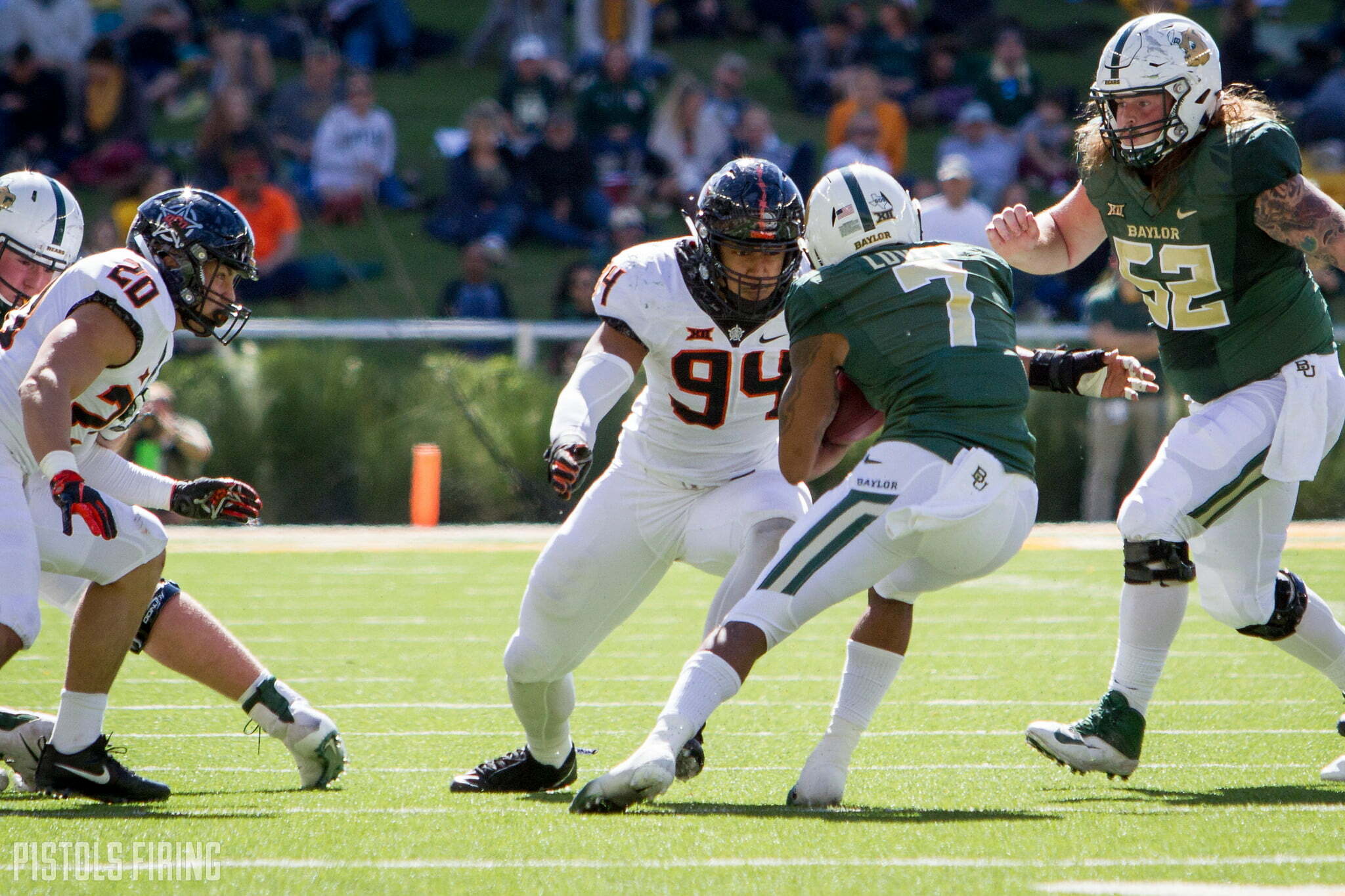
The Oklahoma State Cowboys had a number of mistakes in their 35-31 loss against Baylor last week. Penalties for one, played a huge role in the game, with OSU recording over 130 penalty yards. But the Pokes had a number of other minor mistakes that built up and ultimately led to a disappointing loss.
Aside from the blocked punt, John Lovett’s 75-yard run was the first big play for Baylor. In this play, the Bears are in a closed formation, meaning there’s only a single tight end on one side of the field. Most times, offenses use closed formations to get the ball to the edge, as the field outside of the tight end is usually open.
Here, the Bears use a GT read, meaning they’re pulling the backside guard and tackle, with the play-side lineman blocking down. The Cowboys’ three down lineman are shaded away from the tight end, and A.J. Green, who should act as the force player (the defender who forces all outside plays back to the inside), overruns the play.
The pulling linemen usually have the responsibility of kicking out the end man on the line of scrimmage and climbing to the play-side linebacker, but because Green runs too wide and the line is already away from the point of attack, Green takes himself out of the play, leaving one free lineman to block the second level. Malcolm Rodriguez, who is the one-high safety, takes a bad angle on a tackle and it allows Baylor to earn a 70+ run for a touchdown.
The Cowboys’ second major mistake was on a fourth-quarter passing touchdown. The Bears checked to a smash concept at the line of scrimmage. The outside receiver runs under while the slot receiver runs to the corner, which is designed to put the flat defender in a hi-lo conflict.
A.J. Green puts himself in perfect position on this play but overruns it to the inside, forcing him to turn his head back around and be late to the catch. Both he and Jarrick Bernard fail to make the tackle, allowing Jalen Hurd to score a 36-yard touchdown.
The final play that hurt the Cowboys was a fourth-down attempt in the final quarter. OSU tried a rollout off a jet slice inside running play. Jelani Woods, who was the Cowboy Back on the play, was likely the intended receiver here, as his role is to slide toward the flat.
But because he was aligned where a tight end would be and not in the backfield, it takes him a while to run across the formation. When he does, James Lynch (93) prevents him from running much farther, which throws off the timing. Although Taylor Cornelius had Tyron Johnson open in the middle of the field, he had too many defenders around him to allow him to get a clean throw off.
The Cowboys had many missed opportunities, but hopefully this article shows how the difference between a good and bad play can be almost too small to notice to the average fan (e.g. the angle of a pursuit or coverage or the timing of a pass). They might not be too significant on their own, but when you combine two of them in the same instance (poor coverage and bad tackling), you put yourself in position to struggle.


What Braydon Nelson’s Cowboy Debut Means for OSU’s Offense Against UCF and Beyond

Report: Former Oklahoma State Coach Mike Gundy Set to Be on TNT’s Coverage of Arizona-West Virginia This Weekend

Kick Time Announced for Oklahoma State’s Week 7 Trip to Houston

‘He’s Been Great Like Always’: Eric Morris Addresses Ongoing Chad Weiberg Saga at Weekly Media Availability

Three Things UCF Coach Scott Frost Said Ahead of the Knights’ Trip to Stillwater

Game Preview: Kick Time, TV Info, Stats for Oklahoma State-UCF

PFB Picks: Predicting Oklahoma State’s Week 6 Game Against UCF

Pistols Firing Podcast Ep. 728: UCF Preview

Daily Bullets (Oct. 9): Wyatt Young Playing, Reversing the Trend on UCF

Uniforms: Cowboys Striping Orange-Black-Orange for Stripe the Stadium
-
 Football4 days ago
What Braydon Nelson’s Cowboy Debut Means for OSU’s Offense Against UCF and Beyond
-
 Football4 days ago
Report: Former Oklahoma State Coach Mike Gundy Set to Be on TNT’s Coverage of Arizona-West Virginia This Weekend
-
 Football5 days ago
Kick Time Announced for Oklahoma State’s Week 7 Trip to Houston
-
 Football4 days ago
‘He’s Been Great Like Always’: Eric Morris Addresses Ongoing Chad Weiberg Saga at Weekly Media Availability