
Football
Oklahoma State Hired Eric Morris So Bullet Could Run
‘Bullet has got to be in shape.’

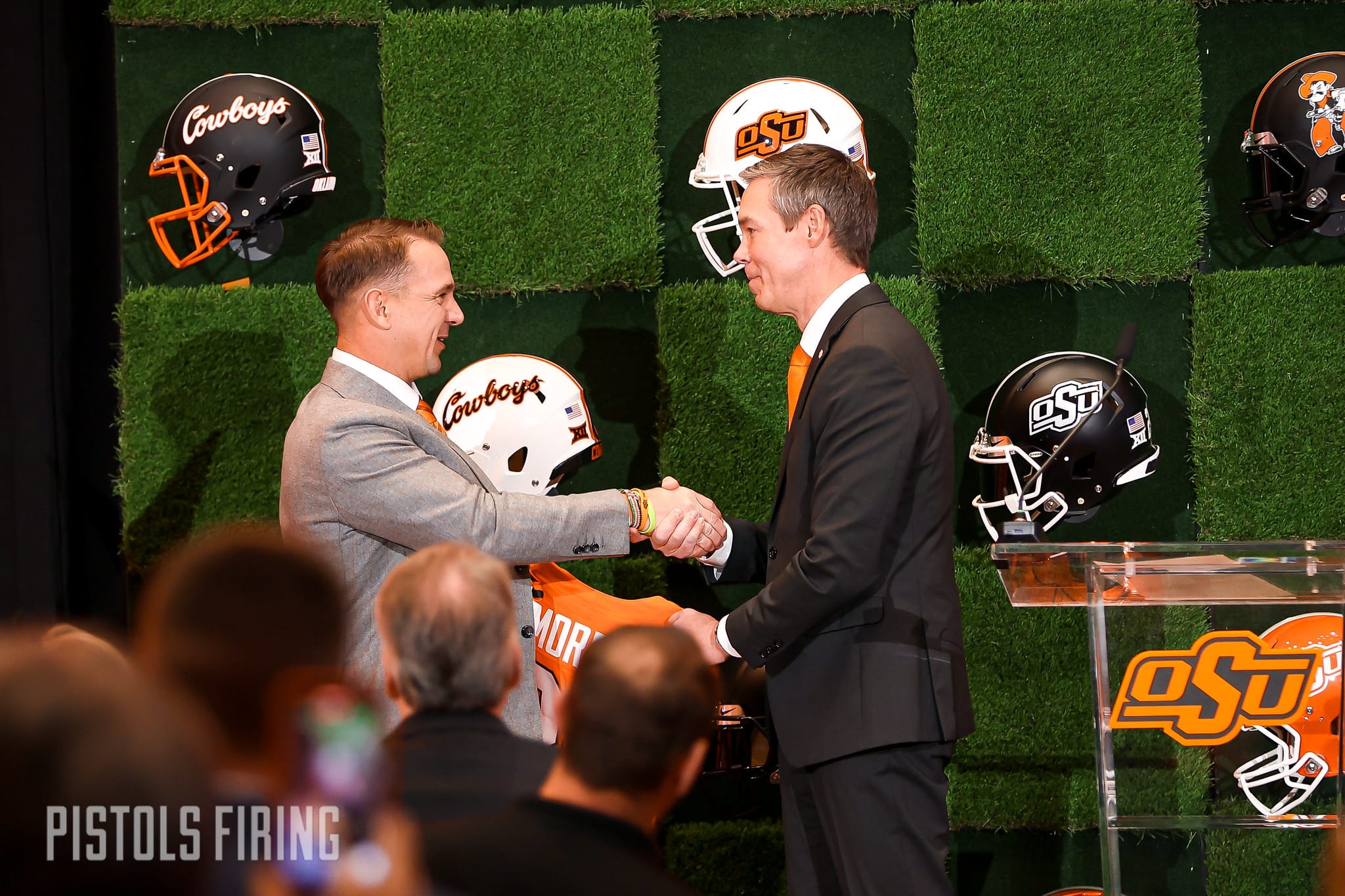
STILLWATER — During his introduction, Oklahoma State coach Eric Morris asked his five-year-old son George to help him out on stage.
George was initially too shy to remind the packed room what OSU’s live mascot name was, but then said “Bullet,” prompting this exchange.
Eric: “When we score a lot of touchdowns, do we need Bullet to be in shape?”
George: “Yes.”
Eric: “You’re dang right we do, Bullet has got to be in shape.”
Then senior associate AD Larry Reece, the stadium announcer during football games, chimed in: “Well, I can tell you right now that the announcer and Bullet are a little out of shape, so we’re gonna have to work on that moving forward. But that’s what we’re excited about with your offense.”
For all of Morris’ well-documented success with quarterbacks, this was why Oklahoma State hired him— to score points.
Morris’ North Texas team led the nation in points per game (44.8) and yards per game (504) while finishing second in yards per play (7.33).
There’s a long list of reasons Weiberg chose Morris.
“His familiarity with Oklahoma, Texas and the Big 12 Conference,” Weiberg said. “He has taken over programs that in some cases don’t have a lot of resources, and he proved that he can solve a lot of problems in building those programs to a championship level. He recruits. He identifies talent. All of those things.
“And then just the person that he is – a relationship builder.”
Weiberg felt confident his conversations with Morris were genuine because the two crossed paths when Weiberg worked at Texas Tech as a deputy athletic director from 2015-17, when Morris worked as the Red Raiders’ offensive coordinator.
“The advantage I had with Coach Morris is that I had been in Lubbock with him,” he said. “I knew that the guy I talked with in the interview was the same guy that he is.”
But when pressed for a reason or two that Morris ended up on Weiberg’s radar initially, he first referred back to his long list, then added one new item.
“But I do think there is value in what your identity is,” Weiberg said. “And obviously this place has been built on offense, scoring a lot of points, you know, those kinds of things. And so what lined up, what aligned with Eric, in addition to all the things that we talked about, is if that’s what he does. And so I thought that just the identity for the program was there, and that was a piece of it for sure.”
What Morris did, leading North Texas to its first 11-win season ever and the brink of the College Football Playoff, was tremendous, but none of that was in place when the search began. What Morris cemented long before this season was his knack for developing some of the best offenses in the nation.
Counting this fall, Morris’ seven teams have finished first in yards per game twice and in the top 10 six different times. The only exception was a 33rd-place finish, which saw Incarnate Word average 417 yards per game.
Morris’ worst finish in points per game saw his group score 29.8 points per contest, good enough for 42nd nationally. Yards per play data isn’t available during two of Morris’ seasons with FCS team Incarnate Word, but his other five groups finished 17th or higher each season, with all of them averaging at least 6.53 yards per play.
OSU has averaged more than six yards per play only twice since 2018, averaging 6.43 and 6.39 in 2018 and 2019, respectively.
Oklahoma State’s offense bottomed out this year in all three statistics, but the Cowboys have been a shell of their former glory for some time. From 2010-2017, the Cowboys averaged at least 38.6 points and 449 yards every season except 2014. Those seven teams also averaged at 5.91 yards per play.
It’s no coincidence that OSU finished 9th or higher in the final BCS/CFP rankings twice in this span (2011 and 2016), and both of these offenses were among the best ever fielded in Stillwater.
The 2011 team holds the school record for points per game (48.7) and finished second ever in yards per play (7.19) and third in yards per game (546), while the 2016 team finished somewhere between sixth and ninth in all three major stats.
That’s the era Weiberg hopes to recapture under Morris’ leadership, and it seems like Morris is only getting better with more resources, despite facing tougher competition at the FBS level.
His North Texas teams averaged 37.6 points per game, 496 yards per game and 6.86 yards per play.
His Incarnate Word teams averaged 35.9 points per game, 485 yards per game and 6.83 yards per play.
Meanwhile, the last seven Cowboys teams averaged 27.9 points per game, 400 yards per game and 5.53 yards per play.
Although plenty has been said and written about Morris’ knack for talent acquisition and development at the quarterback position, Weiberg made it clear that was just one small component of his decision.
“Obviously, that is intriguing, but I think it is just his history of success, period,” Weiberg said. “Where he has been, he’s turned those programs around into winning, winning programs. And at different levels, right? It’s FCS and it’s Group of Five. And so I think that that just says that that person is able to identify and solve problems, whatever they are, they can go into places like that and turn those around and turn them into winning programs.”


Five Thoughts on Oklahoma State 93-85 Exhibition Win Against Tulsa

Eric Morris Compares Drew Mestemaker to Patrick Mahomes, Baker Mayfield as NFL GMs Focus on Stillwater

Three Cowboy Starters Injured In Win Over Colorado

‘They Tried Our Corners’: Deion Sanders Talks OSU’s Offensive Success, Boone Pickens Stadium Atmosphere

Forget Year 1 Talk, Cowboys Chasing Championships Right Now

Five Thoughts on Oklahoma State’s 82-65 Exhibition Loss to Wisconsin

Eric Morris Not Overlooking Halloween Visit to Iowa State Against Aiden Flora

Three Things Iowa State Coach Jimmy Rogers Said Ahead of Oklahoma State’s Trip to Ames

Former UCO Duo Taking Over Key Roles for Oklahoma State Offense

Eric Morris ‘Hopeful’ to Get Quinton Hammonds Back, Speaks Highly of Cameron Epps
-
 Hoops4 days ago
Five Thoughts on Oklahoma State 93-85 Exhibition Win Against Tulsa
-
 Football4 days ago
Eric Morris Compares Drew Mestemaker to Patrick Mahomes, Baker Mayfield as NFL GMs Focus on Stillwater
-
 Football3 days ago
Three Cowboy Starters Injured In Win Over Colorado
-
 Football2 days ago
‘They Tried Our Corners’: Deion Sanders Talks OSU’s Offensive Success, Boone Pickens Stadium Atmosphere