
Football
How Many Running Backs Does It Take to Make an Offense Run?
Breaking down running back usage rates and what stands out about the guys in OSU’s room.

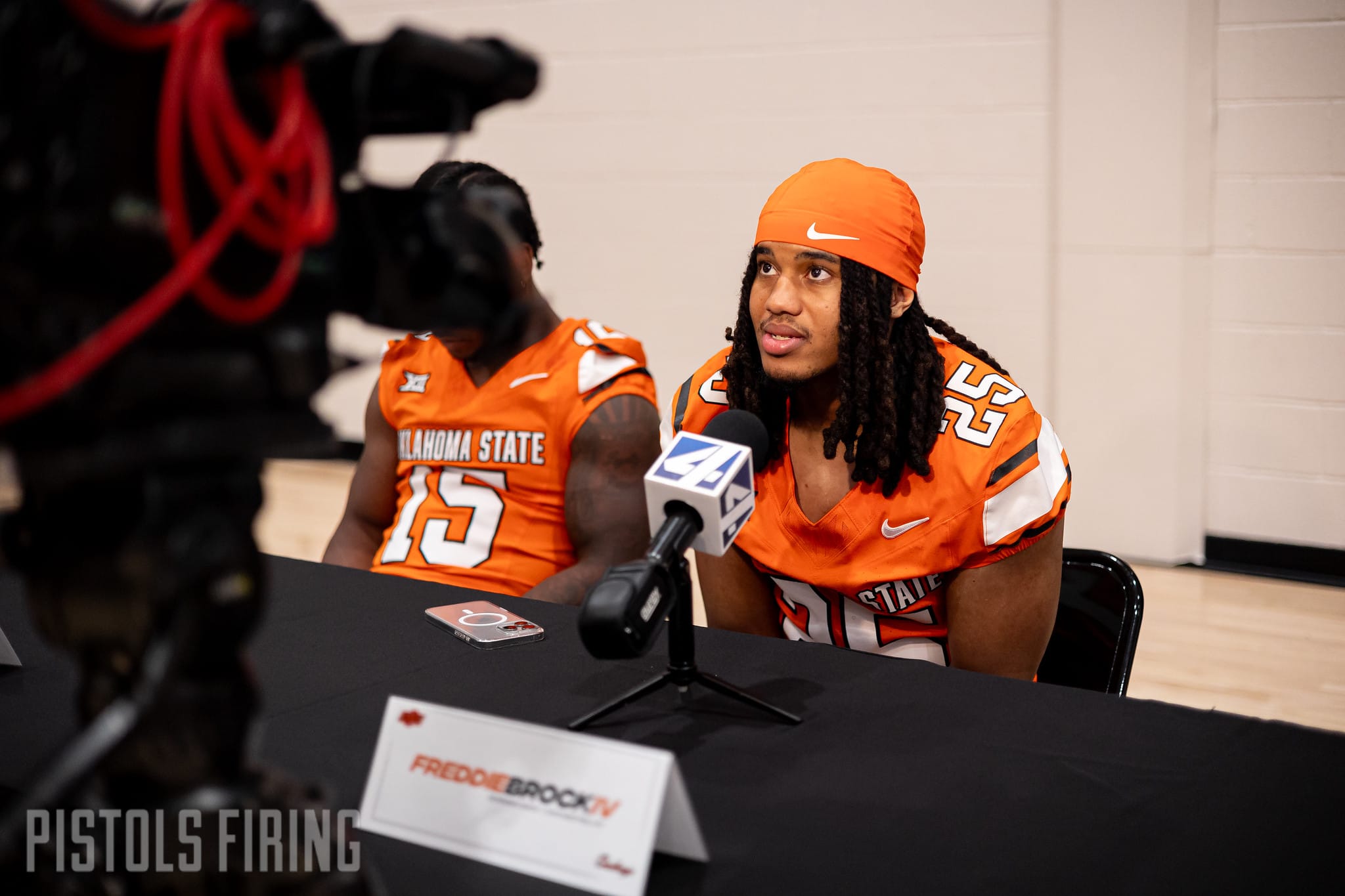
STILLWATER — Oklahoma State players spent most of fall camp praising the running back room for its depth, seemingly for good reason.
Three backs on the roster (Trent Howland, Freddie Brock IV and Rodney Fields Jr.) have proven themselves in either a Cowboys uniform or elsewhere, while two others (Sesi Vailahi and Kalib Hicks) are still looking to really have their breakout moment.
There’s also a pair of freshmen in Jaden Allen-Hendrix and DJ Dugar Jr. waiting in the wings to prove they belong in the mix as well.
Depth is great, but how many running backs do the Cowboys actually need?
Recent history tells us three.
Running Back Averages from 2021-24
| Percent use | Touches (carries+targets) | Largest % workload | Smallest % workload | |
| RB 1 | 63 | 229 | 76 (2023) | 48 (2022) |
| RB 2 | 18 | 64 | 22 (2022) | 15 (2023) |
| RB 3 | 13 | 47 | 20 (2022) | 7 (2023) |
| RB 4 | 7 | 25 | 10 (2022) | 2 (2023) |
That data nearly matches last season’s results exactly. Ollie Gordon led the way with 228 touches, Vailahi finished second with 55, Howland took third with 44 while Fields finished with 25 in large part due to limitations required to redshirt.
Of course everything could look drastically different under new OC Doug Meacham, but the increased reliance on the transfer portal and other changes to college football make it tough to look back at his previous stops as OC here.
For now, let’s assume Oklahoma State is looking for three running backs with a fourth there in a limited, possibly emergency-type role.
Although it wouldn’t be a complete shock to see Hicks earn a role somewhere in that rotation, especially since he has impressed his new teammates during fall camp, he doesn’t have much playing time at the college level to back it up. He only carried the ball five total times during two seasons as a Sooner.
So for the most part, let’s focus on the four who have played significant snaps in college.
Bellcow Back
The Cowboys starter needs to handle a significant workload. Oklahoma State’s most used running back during each of the last four years has finished with 65%, 76%, 48% and 61% of the position’s total touches. In the 2022 season, Dominic Richardson ceded more time than usual to a freshman Ollie Gordon and Jaden Nixon who finished with 22% and 20% of the workload, respectively. Richardson missed three four games that season.
Based on the last four years, Oklahoma State backs will get roughly 30 plays per game to make a difference, so the top guy needs to handle at least 16 touches per game. With Gordon around, returning Cowboys haven’t had the chance to do that while playing for the Cowboys.
Howland had a career high 19 total touches against Michigan State in 2023 while at Indiana. He also got 13 against the week before that. Last season he saw 10 looks twice for the Cowboys and finished the season as the clear-cut second option behind Gordon, outsnapping Vailahi 45 to 19 in the final three weeks of the season.
Vailahi saw a career-high 10 total touches once last season while Fields set his best mark at eight in his college debut at BYU.
Brock, a transfer from Georgia State, could be the wildcard here. In the last two seasons, he has six games with somewhere between 15-18 touches plus a monster showing at Utah State that saw him carry the football or receive a target on 26 plays.
He holds the clear edge here assuming he can handle the step up in power conference competition.
Takeaway: Brock takes this one followed by Howland while Fields feels like a darkhorse in this category.
More Than One Thing
Oklahoma State’s top back recently has also either dominated the position from a pass-catching perspective or at the very least finished a competitive second while the No. 2 back finishes with roughly one target per game.
The outlier season is once again 2022 as OSU’s top three backs in overall usage finished with 23, 15 and 25 targets respectively. Although not essential to be a dominant receiving threat, the Cowboys and the greater football world has shown an increasing tendency to prefer backs that can get it done both on the ground and through the air.
At the FBS level, Brock has caught 24-of-31 targets for 190 yards and one touchdown.
The rest not so much.
Vailahi: 10-of-15 targets for 58 yards
Howland: 6-of-7 targets for 29 yards
Fields: 2-of-4 targets for 23 yards
At this point in his career, it would be odd to see Howland add that to his game in a major way. For the younger trio, it’s possible they just haven’t been given a chance.
High school receiving stats according to MaxPreps
Vailahi: 84 catches for 1,673 yards and 20 TDs (34 games)
Fields: 56 catches for 1,105 yards and 11 TDs (30 games)
Hicks: 25 catches for 226 years and 2 TDs (34 games)
Takeaway: This feels like the aspect of the position that is most open for competition. Vailahi clearly earned pass-catching work under the former coaching staff. Unless Fields overtakes him in this area it feels like he should retain a sizable, likely top two role.
Once again Brock’s experience sets him apart, but with those numbers this feels like a spot he could be beaten by anyone other than perhaps Howland.
Something Special
Of course truly great college running backs create highlights out of plays that seem improbable. Some of these plays take great speed and elusiveness while others just take raw power.
Of course the best can do both.
| Avg yards after contact | Runs per missed tackle | |
| Brock (2024) | 3.98 | 4.7 |
| Howland (2023) | 3.27 | 10.7 |
| Vailahi (2024) | 1.81 | 10.5 |
| Fields (2024) | 3.67 | 7 |
To avoid bias from a small sample size, the chart above reflects stats from the season where these guys got the most attempts at the FBS level. These numbers largely seem to reflect who these guys have proven to be given their respective workloads.
The one exception could be Howland. Despite carrying the ball only 41 times last season, his average yards after contact increased slightly to 3.63, while his runs per missed tackle skyrocketed to 2.7.
Conversely it wouldn’t be a shock to see Brock’s numbers dip against what should be much harder competition in the Big 12.
Takeaways: This number is probably the biggest hurdle between Vailahi and a starting job. Howland, Fields and Brock feel relatively competitive in yards after contact. If Fields can increase his elusiveness a little bit then they all might be close in missed tackles forced this season as well.


Daily Bullets (Oct. 3): Happy Bye Week, An Eye on the Weiberg Situation

Report: Braylin Presley Has Rejoined Oklahoma State’s Football Team

OSU Football: Eric Morris Gushes about ‘The Walk,’ Is Excited to See BPS Next Saturday

Bye-Week Fodder: How Some Former Cowboys Are Doing in Their New Spots

Big 12 Update: Baylor Dominates Arizona State, West Virginia’s Defense Stinks

Wyatt Young, Johnny Dickson III Listed as Questionable on Initial Player Availability Report

Skyler Cassity Built Jerry Lawson’s Confidence Up in the FCS, Now He’s the Cowboy’s Most Consistent DT

Eric Morris Tells Brandon Walker What He Thinks Is Possible for the Remainder of OSU’s Season

‘It’s a Dream Come True’: OSU Legacy Jalen Montonati Discusses His First Official Months as a Cowboy

David Pollack Calls Drew Mestemaker ‘The Future No. 1 Pick in the NFL Draft’
-
 Daily Bullets5 days ago
Daily Bullets (Oct. 3): Happy Bye Week, An Eye on the Weiberg Situation
-
 Football3 days ago
Report: Braylin Presley Has Rejoined Oklahoma State’s Football Team
-
 Football5 days ago
OSU Football: Eric Morris Gushes about ‘The Walk,’ Is Excited to See BPS Next Saturday
-
 Football5 days ago
Bye-Week Fodder: How Some Former Cowboys Are Doing in Their New Spots