
Football
The Final Draw: Did UCF Expose Cracks in the Cowboy Defense That Houston Can Exploit?
A deep dive into OSU’s win against UCF.

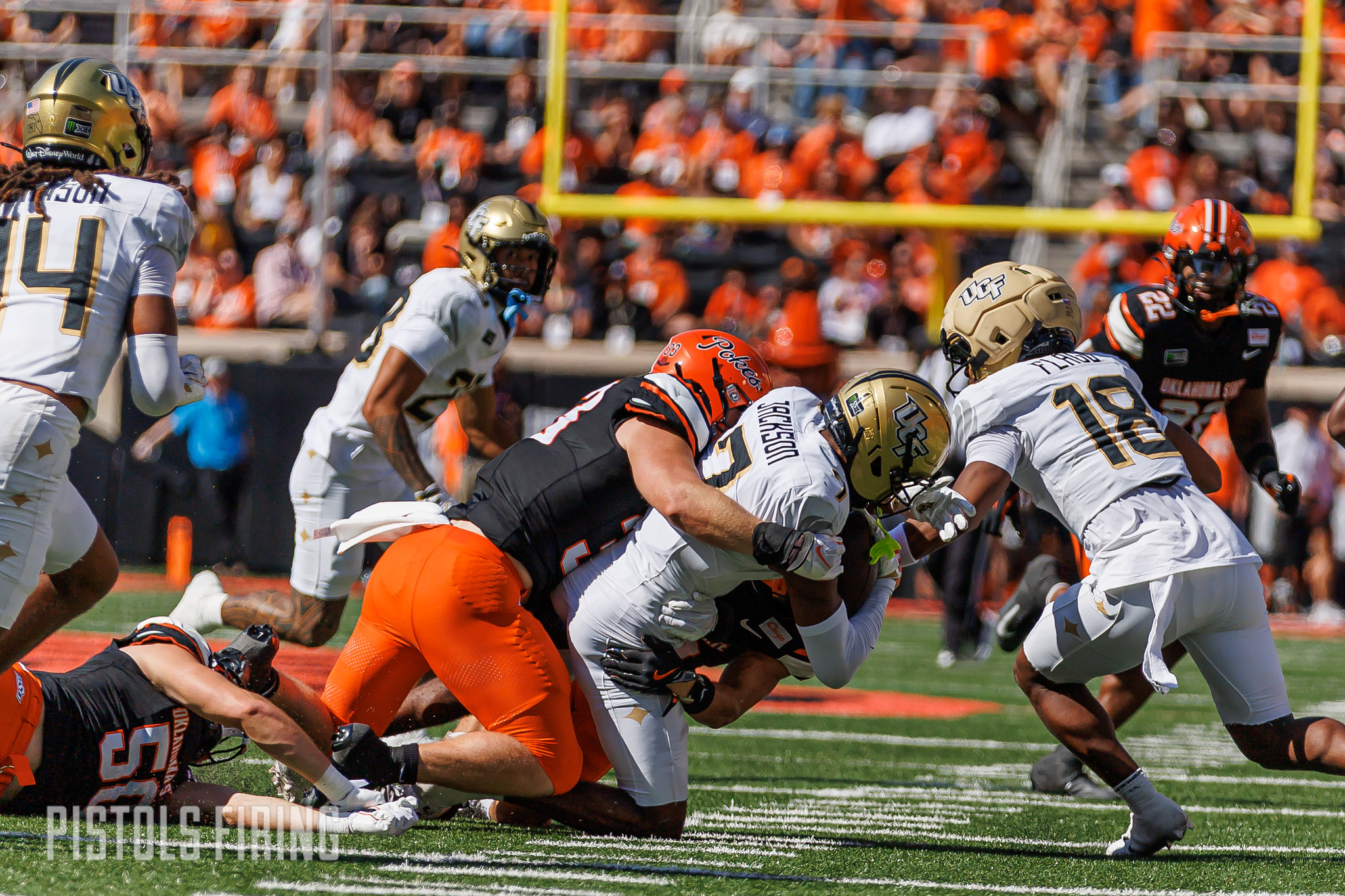
STILLWATER — Oklahoma State did what good teams do and pulled away from UCF on Saturday despite a less-than-ideal start. However, for the second game in a row, OSU’s defense showed some real cracks.
At West Virginia, given the Mountaineers’ success running the ball and the circumstances of the game itself, it felt okay to not dwell as much on defensive miscues in that one.
But to do so against a depleted UCF offense is another thing, especially with a trip to No. 20 Houston up next.
Today’s Final Draw will cover:
– Did UCF’s quick-game passing attack reveal something about the Cowboys’ defense?
– How does the defense hold up against TEs? (Hint: That matters a lot next week)
But first, let’s take a much closer look at Oklahoma State’s defense in high-leverage moments.
OSU entered Saturday’s competition ranked second in red zone defense (60%), 12th on fourth down (22%) and 16th on third down (28%).
On Saturday, UCF went 4-for-4 in the red zone (100%), 4-for-5 on fourth down (80%) and 7-for-16 on third down (44%). None of those numbers are great, and the third down number is the only one you can even remotely excuse.
Red Zone, Woah
The Knights ran 11 plays in the red zone. Of those, four were successful plays by OSU, where the Cowboys held UCF to one yard or less without giving up a touchdown, with the most impressive play coming on 1st-and-2 when OSU’s defense won the point of attack on a hurry-up play with cornerback Mo Horn coming in high for the most important part of the tackle.
The other seven plays resulted in gains of 18, 1 (TD), 12 (TD), 3 (TD), 7, 3 and 4 (TD).
2nd-and-11 at the OSU 20: 18-yard RB run when linebacker Ethan Wesloski and others were blocked out of play on the edge.
3rd-and-1 at the OSU 1: 1-yard reception when UCF quarterback Keyone Jenkins lines up under center, then quickly rolls out to his left and hits tight end Grayson Brousseau, who is wide open in the end zone. Cornerback LaDainian Fields rushes on this play when he sees Jenkins roll out. It seems likely that either someone else was supposed to cover Brousseau/that portion of the field or Fields wasn’t supposed to go after the quarterback there.
1st-and-10 at the OSU 12: Pop pass for 12 yards when Tate Romney’s arm tackle isn’t enough to bring him down. Safety Quinton Hammonds is in the area but expertly blocked out of the play.
1st-and-3 at the OSU 3: 3-yard reception when the UCF receiver makes a good cutback that provides plenty of separation against Horn.
2nd-and-10 at the OSU 14: 7-yard RB run. Hard to tell for sure based on broadcast angle, but it looked like corner Kobi Foreman probably could have made a play closer to the line of scrimmage with better execution.
3rd-and-3 at the OSU 7: 3-yard RB run when OSU’s defense just beat at the point of attack.
1st-and-4 at OSU 4: 4-yard reception with tight end Caden Piening left wide open in the end zone. Hard to tell what happened here. Safety Evan Jackson blitzed and created a little pressure here on the throw. It both seems like he left the area Piening found and followed instructions to go for the quarterback, so it is hard to say for sure what went wrong on this one. Sometimes you do see defenses just leave gaps in the end zone due to the amount of bodies you need to win against the run.
Overall conclusion: This all feels like a real concern. As was the case for much of the game, OSU defenders often got blocked out of plays on the perimeter that turned into decent gains if not first downs (or touchdowns) for the Knights.
Mistakes or even less than ideal calls will happen, but giving up multiple wide-open touchdown passes feels more like a genuine issue. However, not stopping the UCF back from picking up the first down when he needed three yards felt like the single biggest red zone fault given the stakes of that play and OSU’s inability to win at the point of attack.
Fourth and Forget It
The Knights were 3-of-3 on fourth down in the first half and finished 1-of-2 in the fourth quarter when the outcome was either decided or their backs were against the wall.
Here are those plays in order (skipping Luke Webb’s stop covered extensively by PFB after the game).
Needing 2 yards: 15-yard completion (11 after the catch). Looked like Hammonds had responsibility here, but he’s rubbed out of the play by a crossing route that creates traffic in the middle of the field. This one felt less like his fault and more like good play design from the Knights.
Needing 1 yard: 1-yard RB run. The UCF offensive line wins enough at the point of attack to give the running back two efforts to push for the line to gain.
Needing 4 yards: 9-yard completion. Jenkins was rushed out of the pocket on this play, and it took a heckuva a throw-and-catch at the sideline to move the chains here against Romney. Given the fact that video review had to double-check this one, I’m okay not faulting the OSU linebacker who had impressively tight coverage on the tight end.
Needing 3 yards: 4-yard completion. At the time, OSU held a 21-point lead with roughly five minutes to play, so it’s fair to play this one pretty conservatively. However, the receiver is left all alone running even with the line to gain. Instead of forcing a contested catch, OSU defenders play at least two or three yards back, perhaps even more.
Overall conclusion: I’m less worried about the fourth-down conversions. At least one was a great play design, one came on an insane catch, another came when it was clear either the OSU players or coaches themselves were more worried with limiting explosive plays than getting off the field. And running on 4th-and-1 feels like something offenses should just get at least 50% of the time, so overall none of this felt indicative of OSU’s fourth-down defense truly crumbling.
Third Down for What
We’ve already covered two of UCF’s third-down successes that came in the red zone (and seemed problematic on rewatch). Before breaking down the others, it’s worth noting that UCF’s fourth touchdown probably should have been scored almost two minutes faster, as Jenkins overthrew a wide-open receiver in the end zone. That would have put OSU’s offense out with six minutes to protect a 14-point lead instead of four minutes.
Given how efficiently the Cowboys moved things, it likely doesn’t matter, but it would have added way more pressure on starting the drive well.
Of the remaining 13 plays, seven either resulted in first downs or set the Knights up to go for it on fourth down from a manageable distance.
Needing 1 yard: Jenkins sneaks for three yards. The extra yards gained here impressed more than the fact that UCF got it. OSU’s line just got beat on this play.
Needing 10 yards: 9-yard RB run when no OSU players are on the outside. Defensive end DJ Jackson moves inside, seemingly to take advantage of a hole created by the offensive line. This just sucks him inside and out of the play. Linebacker Isaiah Chisom eventually makes the tackle, but it takes him a bit to bring the runner down.
Needing 6 yards: 12-yard completion (eight after catch). It looked like Malik Charles hit Jenkins, but that wasn’t enough to stop the wide-open catch two yards short of the line to gain. Based on the structure of the defense, it feels like Romney is the guy who should have made this play here.
Needing 3 yards: 4-yard RB run off read option. Again, no one seems well positioned to make this play. UCF had two guys in the backfield with the quarterback, and given the way OSU was slanted down on the other side, it feels like the Cowboys expected the play to go the other way.
Needing 5 yards: 6-yard reception by a tight end who caught the ball at the line of scrimmage when nickel Christian Bodnar and Fields were blocked out of making a play on that side. Hammonds gets there, but it’s too late. Several of the third-down failures by UCF were due to Wesloski’s quick reaction time and sure tackling, but on this one it feels like OSU needed better play recognition and reaction from him.
Needing 10 yards: 11-yard catch. Corner Kollin Lewis is unable to keep up on this play, however, the receiver pushes him at the top of the route before cutting away. Both in the press box and on rewatch, it felt like this should have gone down as offensive pass interference.
Needing 11 yards: 10-yard completion (five after the catch). Bodnar goes low on this play, and the receiver hurdles him to set the Knights up with 4th-and-1.
Overall conclusion: I’m happy to ignore the play where the officials hung Lewis out to dry and the sneak. But the wide-open receiver should have been a touchdown. That gives the Knights eight strong plays on third down (out of 17). That’s way too many if OSU wants to make real noise in the Big 12 this season.
It was especially concerning to see how often the Cowboys didn’t even appear to be in the area to make a play on some of these third downs.
Does Oklahoma State Have a TE Problem?


10 Thoughts on Oklahoma State’s 42-28 Victory Against UCF

‘Fondest Memories of My Life’: Mike Gundy Discusses Oklahoma State on TNT

Big 12 Power Rankings Going into Week 6

OSU’s Top Defender Started as a Walk-On at UNT but Dreamed of Playing for OSU Since He Was 4

Uniforms: Cowboys Striping Orange-Black-Orange for Stripe the Stadium

The Final Draw: Did UCF Expose Cracks in the Cowboy Defense That Houston Can Exploit?

Friday Night Highlights: Two OSU Receiver Commits Have 100-Yard Games

Three Things Houston Coach Willie Fritz Said Ahead of Oklahoma State’s Game Against the Cougars

NFL Update: Jaylen Warren Makes History, Justice Hill Breaks Loose, Ollie Gordon Scores Again

Scott Frost Says He’ll Be ‘Surprised’ if Drew Mestemaker Is in College Next Year
-
 Football2 days ago
10 Thoughts on Oklahoma State’s 42-28 Victory Against UCF
-
 Football2 days ago
‘Fondest Memories of My Life’: Mike Gundy Discusses Oklahoma State on TNT
-
 Football4 days ago
Big 12 Power Rankings Going into Week 6
-
 Football4 days ago
OSU’s Top Defender Started as a Walk-On at UNT but Dreamed of Playing for OSU Since He Was 4